
The Trevi Fountain is a world famous 18th-century fountain in Rome, Italy. It was designed by Italian architect Nicola Salvi and completed in 1762. At a height of 26.3 meters (86 ft) high and width of 49.15 meters (161.3 ft), it is the largest Baroque fountain Rome and one of the most famous fountains in the world.

The fountain marks the terminal point of the “modern” Acqua Vergine—the revived Aqua Virgo, one of the aqueducts that supplied water to ancient Rome for 400 years starting around 19 BC. During the 6th century, the aqueducts were damaged during the invasion of the Ostrogoths. In 1629, Pope Urban VIII asked Gian Lorenzo Bernini to sketch possible renovations, but the project was abandoned when the Pope died. A century later, In 1730, Pope Clement XII organized a contest in which Nicola Salvi was eventually awarded the commission to design the fountain. Salvi died in 1751 with his work half finished. The Trevi Fountain was finally finished in 1762 by Pannini, who substituted the present allegories for planned sculptures of Agrippa and Trivia, the Roman virgin. It was officially opened and inaugurated on 22 May by Pope Clement XIII.
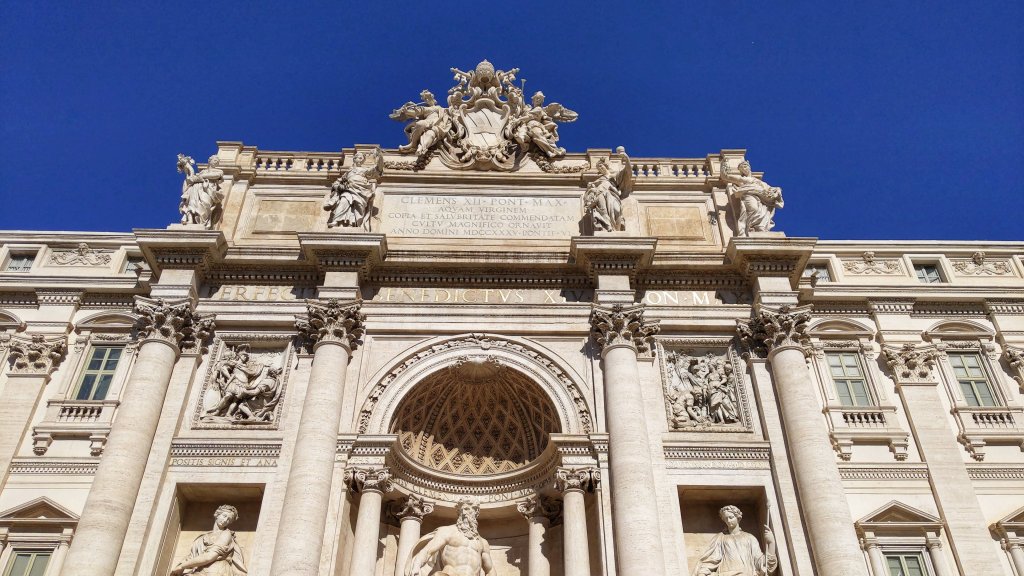
The backdrop for the fountain is the Palazzo Poli, given a new façade with a giant order of Corinthian pilasters that link the two main stories. Taming of the waters is the theme of the gigantic scheme that tumbles forward, mixing water and rock work, and filling the small square. Tritons guide Oceanus’s shell chariot, taming hippocamps.
In the centre, a robustly modeled triumphal arch is superimposed on the palazzo façade. The centre niche or exedra framing Oceanus has free-standing columns for maximal light and shade. In the niches flanking Oceanus, Abundance spills water from her urn and Salubrity holds a cup from which a snake drinks. Above, bas reliefs illustrate the Roman origin of the aqueducts. The Tritons and horses provide symmetrical balance, with the maximum contrast in their mood and poses.

Coins are purportedly meant to be thrown using the right hand over the left shoulder. An estimated 3,000 euros are thrown into the fountain each day with an estimated €1.4 million (US$1.5 million) thrown into the fountain annually. The money has been used to subsidize a supermarket for Rome’s poor; however, there are regular attempts to steal coins from the fountain, even though it is illegal to do so.
Watch the video clip below for a virtual of Trevi Fountain in Rome, Italy.
 All Around The World