
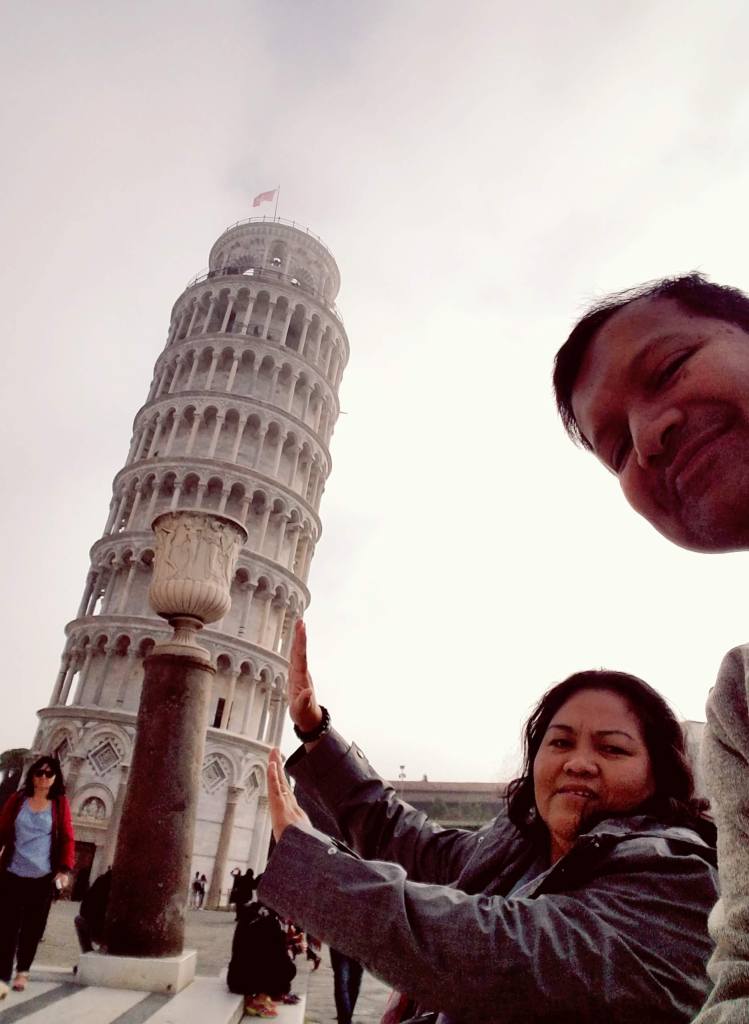
The Leaning Tower of Pisa is the campanile, or freestanding bell tower, of Pisa Cathedral. It is known for its nearly four-degree lean, the result of an unstable foundation. The tower is one of three structures in the Pisa’s Cathedral Square (Piazza del Duomo), which includes the cathedral and Pisa Baptistry.

The tower has a height of 55.86 metres (183 feet 3 inches) and 296 or 294 steps; the seventh floor has two fewer steps on the north-facing staircase.
The tower began to lean during construction in the 12th century, due to soft ground which could not properly support the structure’s weight. It worsened through the completion of construction in the 14th century. By 1990, the tilt had reached 5.5 degrees. The structure was stabilized by remedial work between 1993 and 2001, which reduced the tilt to 3.97 degrees.
Between 1589 and 1592, Galileo Galilei, who lived in Pisa at the time, is said to have dropped two cannonballs of different masses from the tower to demonstrate that their speed of descent was independent of their mass, in keeping with the law of free fall.
The tower and the neighboring cathedral, baptistery, and cemetery are included in the Piazza del Duomo UNESCO World Heritage Site, which was declared in 1987. Watch the video below to learn more about this famous historic structure.
 All Around The World