
Assisi is a town in the Umbria region in central Italy. It is the birthplace of several famous historic figures such as the Latin poet Propertius (around 50 BC), St. Francis, the founder of Order of Friars Minor and St. Clare of Assisi, founder the Order of Poor Ladies (later known as Order of Poor Clares) in the 13th century and St. Gabriel of Our Lady of Sorrows in the 19th-century.
The earliest attested people of Assisi were the Umbri. In 77AD Pliny the Elder described Regio VI Umbria and said that the Umbri were thought to be the oldest inhabitants of Italy. The Romans took control of central Italy in 295 BC. They built the flourishing municipium Asisium on a series of terraces on Monte Subasio. Roman remains can still be found in Assisi: city walls, the forum, a theater, an amphitheatre and the Temple of Minerva (now transformed into the Church of Santa Maria sopra Minerva). In 1997, the remains of a Roman villa were also discovered containing several well-preserved rooms with frescoes and mosaics in a condition rarely found outside sites such as Pompei.


The town is dominated by two medieval castles. The larger, called Rocca Maggiore, is a massive reconstruction by Cardinal Albornoz in 1366 and expanded later expanded in the 15th and 16th century by the Popes. The smaller Roman era castle has been only partially preserved, a small portion and three towers being open to the public.
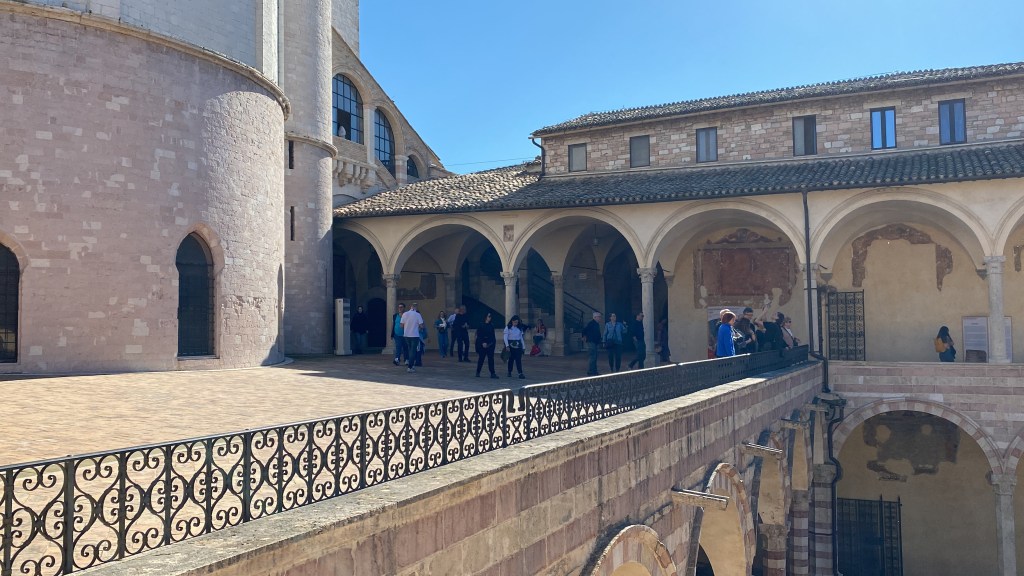

In 238 AD Assisi was converted to Christianity by bishop Rufino, who was martyred at Costano. According to tradition, his remains rest in the Cathedral Church of San Rufino in Assisi. The Ostrogoths of king Totila destroyed most of the town in 545. Assisi then came under the rule of the Lombards as part of the Lombard and then Frankish Duchy of Spoleto.
The thriving commune became an independent Ghibelline commune in the 11th century. Constantly struggling with the Guelph Perugia, it was during one of those battles, the battle at Collestrada, that Giovanni di Bernardone (better known as St. Francis of Assisi) was taken prisoner, setting in motion the events that eventually led him to live as a beggar, renounce the world and establish the Order of Friars Minor.


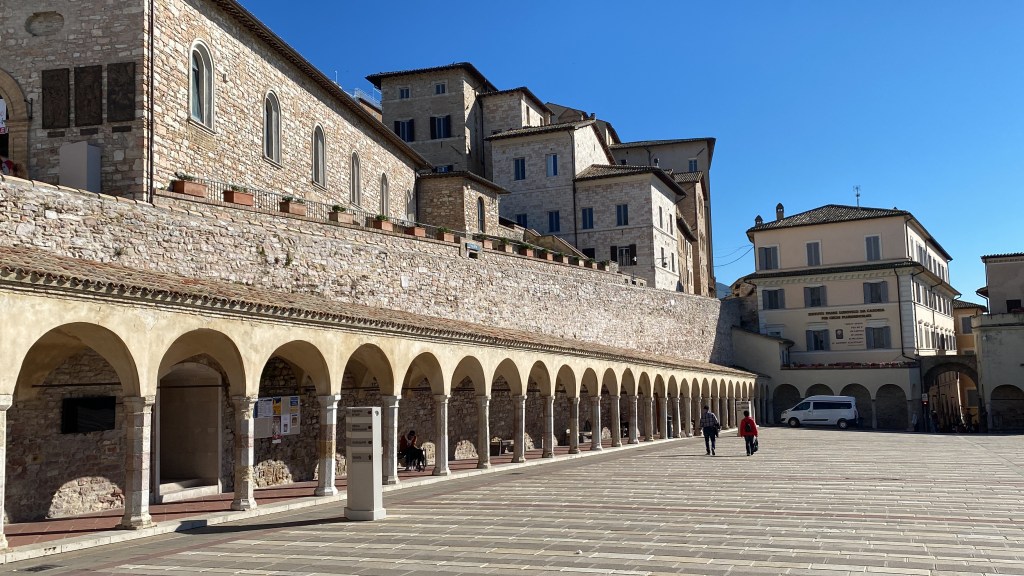

The scenic town is well connected to public transportation by major train route from Rome, Bologna or Florence. It is also little over 2 hours drive by car from Rome. The town is a popular stop for tour group excursions in Tuscany and Umbria region of Italy.
The city, which had remained within the confines of the Roman walls, began to expand outside these walls in the 13th century. In this period the city was under papal jurisdiction. The Rocca Maggiore, the imperial fortress on top of the hill above the city, which had been plundered by the people in 1189, was rebuilt in 1367 on orders of the papal legate, cardinal Gil de Albornoz.
In 1569 construction was started of the Basilica of Santa Maria degli Angeli. During the Renaissance and in later centuries, the city continued to develop peacefully, as the 17th-century palazzi of the Bernabei and Giacobetti attest.
Assisi is linked in legend with its native son, St. Francis, who founded the Franciscan order and shares honours with St. Catherine of Siena as the patron saint of Italy. He is remembered by many, even non-Christians, as a lover of nature (his preaching to an audience of birds is one of the legends of his life).
 All Around The World
One response to “A Brief History of Assisi, Italy”
Assisi and its surroundings look beautiful and it sounds like it has a very interesting history. I’ve been to a number of places in Italy (it’s my most visited country), but I’ve never been to Assisi. I should probably correct that oversight. Thanks for the post.
LikeLike